In physics there are of course no miracles, and if flight is to be meaningfully understood, every action of the airplane must be explained in terms of a force. That is, 1) what force is acting on the airplane? and 2) what is causing that force to happen? The controls don't magically cause the airplane to do things, but rather they cause forces to happen, which in turn cause the airplane to do those things.
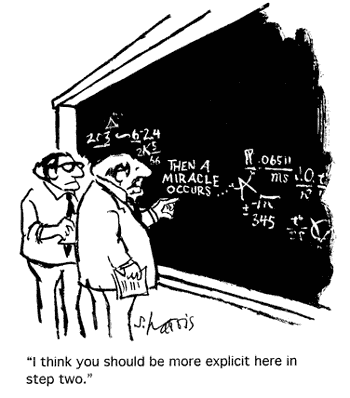
To summarize this incomplete view akin to Sidney Harris's famous comic strip...
1. The airplane banks -> 2. Then a miracle occurs -> 3. The airplane turns.
or, more generally,
1. We move the controls -> 2. Then a miracle occurs -> 3. The airplane does something.
What I've set out to do is to clear up any fuzziness in step 2 and explain it in terms of forces. The interaction of forces and objects is a matter of basic physics, and that must be understood first (though we may find it boring) before we can talk about its subset, aerodynamics (which greatly concerns us).
"Perhaps one should read up on elementary physics - on the laws of motion, on gravitation, on the behavior of falling bodies, on the difference between steady motion and acceleration. Certainly a flight instructor should understand all that to keep from talking nonsense. It may be just classroom sort of theory for people who work at desks, but it is practical insight into everyday affairs for people who work in a cockpit, moving in three dimensions and with six degrees of freedom." - Wolfgang Langewiesche, Stick and Rudder
What is a force? In short, a force is any "push" on an object. What does a force do? It makes the object move. (Note to the careful readers: I am not distinguishing here between steady motions and accelerations. I originally did in 3 paragraphs that I deleted because they belabor the point here, and I'll probably cover in future posts. Any time I say "move" in this post, I mean "accelerate") It is immensely important to realize that there are two aspects of every force: its magnitude, and its direction. The magnitude is just a fancier name for its strength. A bowling ball resting on a floor exerts a force of higher magnitude, or strength, on the floor than does a tennis ball. So much is common sense. But what is not commonly thought about is the direction the force is acting. The reason it's not so often thought about is that it's so obvious, and therefore doesn't elicit any thought, in a basic case such as that of a resting ball. It's beyond stating that the direction of its weight acts is "down," and would be almost insulting to ask someone that, as a question, in seriousness.
Nearly as obviously as that a bowling ball weighs downward, the "4 forces" on the familiar flight training diagram of an airplane in straight-and-level flight act in their appropriate directions; and we don't have to think very hard about that either. But it's unfortunate that we don't, because as soon as that airplane is no longer in straight-and-level flight, the directions that those forces act change, and those changes become very important in figuring out what (and why) happens; but, too often, they've been relegated as these vague abstractions from what you took to pass the written test, and we don't know what direction they act. The obvious has become obscure. If, in thinking about the 4 forces, you've ever caught yourself rattling them off as "liftweightthrustanddrag" in one breath, then maybe you're not thinking about them carefully and specifically enough.

So we need to go back one step and consider each of those forces carefully in its own right, and each of them with both their magnitudes, and their directions. But that will come in Part 2 of this post, and before that, we have to clarify how we're going to think about them, and how they're represented. Remember the 4 arrows coming out of the airplane diagram? They're not just there as markers to merely represent the forces' presence and help you remember their names.
To see what the arrows mean, we're going to back away from the airplane for a bit and go to the stock victim of basic Newtonian problems, the pool ball. When you hit the ball with the cue, you're applying a force to it. The length of the arrow represents the magnitude (i.e., strength) of the force, and the direction of the arrow represents the direction of the force, which is, in turn, is the direction it will move the ball. A light tap creates a small force, and a hard smack creates a big force.

Of course, we can also vary the direction we're applying the force. When looking down from above, if we hit the ball Northward, it'll move North. If we hit it Westward, it'll move West. And both of these directions are represented by the directions of the arrows.

Another visualization: Rockets. Rockets are another common object we think about when considering forces and motion. In a way, they are an embodiment of the concept of force itself. As far as the existence of a force goes, there is no real difference between pushing and pulling. There is simply a force making the object move this way or that way. So, a pool ball getting hit with a cue from the East, is the same as one getting pulled with a string from the West: in either case, it'll be made to move Westward because of the force. For most rockets, the engines are at the bottom, and apply a force upward (which we would then call a "push.")
But consider the Launch Escape System (LES) for the Apollo spacecraft, a smaller rocket at the top of the whole assembly, designed to pull only the conical Command Module away from the Saturn V launcher in case of emergency. If we consider the Command Module itself to be the object of interest, the LES is a puller rocket. In your gut, as you imagine this rocket to be the very embodiment of a force, make the connection that it looks just like all of the force arrows we have drawn so far, pointing away from the object, toward the direction they're acting: in this case up and slightly to the right.

It seems like I've described these obvious things to an excruciatingly... stupid level of detail, but it matters. It matters because when we start talking about airplanes instead of pool balls and start drawing arrows like these all over the board, now we know exactly what the arrows mean (both their length and direction, and the corresponding force's magnitude and direction). I want every reader to promise me that from here on out, you will never think about any force of the airplane without considering what direction it's acting, and helping yourself do that by mentally drawing an arrow coming out of it in that direction. And as you're thinking about any of the forces acting on an airplane (or even one part of an airplane), imagine it as a rocket pulling it in that direction.
If you ever think about a force without considering its strength and direction (especially its direction), stop because you're thinking nonsense and it will be of no help in figuring anything out about the behavior of the airplane, or the behavior of the pilot.
In Part 2, we'll cast away pool balls and rockets, and apply this to our actual object of interest: the airplane.

No comments:
Post a Comment