Thursday, May 22, 2014

A Forceful Perspective, Part 2: What turns me on

In the last article, we reviewed the basic concept of a force, and the arrow on a diagram that represents it: both its magnitude (i.e., strength, as shown by the length of the arrow) and its direction (as shown by the direction of the arrow). Here I'll introduce the word "force vector," or just "vector", which simply means "force," but carries the reminder that it has a direction and a magnitude. (How many reminders do we need? Well, I'll probably keep flogging that horse a while longer.) And if we're drawing diagrams with arrows, the "vector" can then refer to the arrow itself. As we measure the magnitude of the force in pounds, that's shown by the length of the arrow in inches. So if we're showing 2000 pounds of lift as a 2-inch arrow, then 3000 pounds of lift would be a 3-inch arrow.

The forces in a bank

Now we're ready to look at an actual airplane and its forces, from the front. Here we ignore thrust and drag, which point into and away from the screen. What we do see are lift, doing simply what its name says, pointing straight up at the sky, and weight, pointing straight down. In straight-and-level flight they directly oppose each other with the same strength. If the weight is, say, 2000 pounds, then the lift is also 2000 pounds, so the flight path does not curve up or down, but continues to go in a straight line.


In the second picture, we have a moderate amount of bank angle. Weight, of course, continues to pull straight down toward the Earth. Lift, however, banks with the airplane, and continues to point out of the "roof" of the airplane perpendicular to the wings. This is an important maxim that is a fundamental cornerstone of most of flight dynamics, so I will hit upon it here as a key point: Lift always points perpendicular to the airplane.

You may note that as we continue to bank steeper and steeper, and thus aim the lift vector steeper and steeper, at a certain point lift no longer does what its name implies, since we can aim it at the ground! At this point, it's important to note that "lift" is just a name (that only describes what it normally does in straight and level flight), and when we have it aimed at the ground you'll only get confused by trying to figure how it lifts the airplane; it doesn't. We might as well name it "wing force," since it plainly describes that it's just the force created by the wing. But the name "lift" has stuck, and we have to be careful not to take it to mean any more than it does.
In this picture, so-called "lift" is aimed mostly down, and acts in the same direction as weight; All the forces push it down and nothing opposes them, so you can be sure this airplane will be going down quickly. (How, then, do aerobatic airplanes perform sustained inverted flight? That's a topic for a future article, but in short, we manipulate lift so that it comes out the belly of the airplane rather than the roof. And yes "roof" is a silly word but I use it to avoid any confusion with where up and down are, while the airplane is itself upside down.)

Why does this matter?

Why we bank

Go back to the second picture, with the moderate bank angle:


Recall the question that began my last post: "Why does the airplane turn?" This is why. Very simply put, we have tilted the lift force to one direction, and like Apollo LES rocket it will now pull the airplane in that direction. A force exists to the right (from the pilot's point of view), where none did before; therefore the plane will move to the right, where it wasn't before. Of course, it's only a partial tilt, so the lift force pulls double-duty: it still acts to counter weight (though not as effectively as before) while also turning us. The further over we tilt it, the less it will lift us and the more it will turn us. If we tilt it fully 90 degrees, it will not counter weight at all, but it would turn us most effectively. For a basic description, it really is that simple: You aim your lift vector where you want the airplane to go, so it goes that way.

I've seen students' eyes glaze over when we start breaking down the lift vector into horizontal and vertical components and they start getting flashbacks from high school trigonometry class. I thought flying was supposed to be fun! Well sometimes it takes a little brainwork (and, not to worry, I'll cover this in a future post) but sometimes that brainwork can make you miss the forest for the trees. Anything about vector components and horizontal-this and vertical-that is detailed techniques for calculating how much lift it takes to do one job or the other. For now forget about it and please appreciate the basic notion that you move the airplane around with the lift vector.

A little bank, a little tilt, a little sideways pull, a gentle turn. 
A steep bank, a big tilt, a strong sideways pull, a sharp turn.

The venerated ailerons, for their part, are not very important. They are just one of many methods of establishing the bank (and therefore the lift vector tilt) but the bank itself is the important part, for without it the lift vector won't point sideways, and so we can't have a turn. How about the many airplanes without ailerons? The Wright Flyer, for one, didn't have ailerons but used wing-warping instead. You might object that it's an unfair example since wing-warping still does the same thing as an aileron deflection: moving the trailing edge up or down, just smoothly without a hinge. Fine. How about the B-52? No ailerons, and no wing warping. It uses differential spoilers to meet the objective of establishing a bank and tilting the lift vector. Or weight-shift ultralights: You move the center of gravity to the side, and that makes it bank and tilts the lift vector. In summary, what matters is not how we bank, but why we bank.

Airplane control

Not just turning, but all maneuvering boils back down to the manipulation of the lift vector. Fundamentally, there are 2 things we can do with it: change its direction, as we saw, by banking the airplane with (or without, for that matter) ailerons; and its magnitude, by pitching with the elevator.


In a normal turn, we bank it sideways a little, so it starts pulling us to the side, and we pull back the stick slightly to increase its magnitude to make up for its reduced ability to lift the airplane. Or, from level flight, we can simply pull back on the stick a lot, to increase lift magnitude a lot, so as to curve our flight path upwards into a loop. I can go on with more examples, but the bottom line is that all of flight, from normal maneuvers, to emergency maneuvers, to aerobatics, to aerial combat, can be reduced to working the lift vector in direction and magnitude (or, strength). So, always be asking yourself about your lift vector: 1) where am I pointing it? and 2) how strong am I making it?


When thinking about the mechanics of these interactions, all of this probably isn't Earth-shattering news. My point in laying out these results in so many ways (and repetitions) is to further a meaningful understanding of flight (especially maneuvering flight) by more directly connecting your control inputs to these ultimate results, rather than the basic airplane motions.

Consider a car analogy: If you teach someone from an isolated tribe how to drive a car, while explaining the purpose of the steering wheel, you wouldn't say that it's to control the lateral displacement of the steering rack. While accurate, that doesn't explain much. "To turn" does. Likewise, the purpose of the two possible yoke/stick displacements, is much more than simply to control pitch and roll. Why do we pitch and roll? Like the real purpose of the steering wheel is to turn, the real purpose of moving the yoke is to manipulate the lift vector in the ways discussed earlier. And to help soak that in to your understanding of maneuvering flight, in your mind re-label the motions of the yoke from their direct results in the conventional picture to the left, to their ultimate results in the picture to the right.

Friday, May 16, 2014

A Forceful Perspective, Part 1: Back to Basics

In a very typical exchange with students, I ask them "why does the an airplane turn?" They'll respond that when they apply an aileron input, one aileron goes down while the other goes up, thereby banking the airplane. (If they're sharp, they'll be able to tell me why the differential ailerons cause the airplane to bank.) So far the answer's right, so I'll say "fine," but then also note that they've explained why the airplane banks, but not why it turns; so the question hasn't been answered. Why does the bank cause the airplane to turn? When I press them on this issue, most of the time I get a blank stare or a stammered flurry of random aeronautical words and sideways references to various aspects of turning, and we're left not knowing what has caused the airplane to go in a curve instead of continuing in a straight line.


In physics there are of course no miracles, and if flight is to be meaningfully understood, every action of the airplane must be explained in terms of a force. That is, 1) what force is acting on the airplane? and 2) what is causing that force to happen? The controls don't magically cause the airplane to do things, but rather they cause forces to happen, which in turn cause the airplane to do those things.

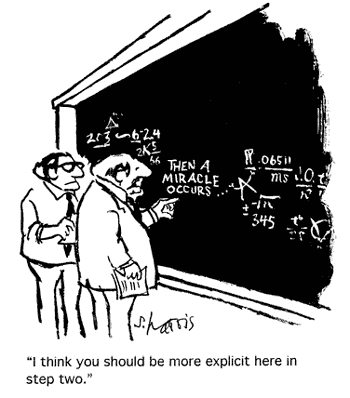
To summarize this incomplete view akin to Sidney Harris's famous comic strip...

1. The airplane banks -> 2. Then a miracle occurs -> 3. The airplane turns.

or, more generally,

1. We move the controls -> 2. Then a miracle occurs -> 3. The airplane does something.

What I've set out to do is to clear up any fuzziness in step 2 and explain it in terms of forces. The interaction of forces and objects is a matter of basic physics, and that must be understood first (though we may find it boring) before we can talk about its subset, aerodynamics (which greatly concerns us).

"Perhaps one should read up on elementary physics - on the laws of motion, on gravitation, on the behavior of falling bodies, on the difference between steady motion and acceleration. Certainly a flight instructor should understand all that to keep from talking nonsense. It may be just classroom sort of theory for people who work at desks, but it is practical insight into everyday affairs for people who work in a cockpit, moving in three dimensions and with six degrees of freedom." - Wolfgang Langewiesche, Stick and Rudder

What is a force? In short, a force is any "push" on an object. What does a force do? It makes the object move. (Note to the careful readers: I am not distinguishing here between steady motions and accelerations. I originally did in 3 paragraphs that I deleted because they belabor the point here, and I'll probably cover in future posts. Any time I say "move" in this post, I mean "accelerate") It is immensely important to realize that there are two aspects of every force: its magnitude, and its direction. The magnitude is just a fancier name for its strength. A bowling ball resting on a floor exerts a force of higher magnitude, or strength, on the floor than does a tennis ball. So much is common sense. But what is not commonly thought about is the direction the force is acting. The reason it's not so often thought about is that it's so obvious, and therefore doesn't elicit any thought, in a basic case such as that of a resting ball. It's beyond stating that the direction of its weight acts is "down," and would be almost insulting to ask someone that, as a question, in seriousness.

Nearly as obviously as that a bowling ball weighs downward, the "4 forces" on the familiar flight training diagram of an airplane in straight-and-level flight act in their appropriate directions; and we don't have to think very hard about that either. But it's unfortunate that we don't, because as soon as that airplane is no longer in straight-and-level flight, the directions that those forces act change, and those changes become very important in figuring out what (and why) happens; but, too often, they've been relegated as these vague abstractions from what you took to pass the written test, and we don't know what direction they act. The obvious has become obscure. If, in thinking about the 4 forces, you've ever caught yourself rattling them off as "liftweightthrustanddrag" in one breath, then maybe you're not thinking about them carefully and specifically enough.


So we need to go back one step and consider each of those forces carefully in its own right, and each of them with both their magnitudes, and their directions. But that will come in Part 2 of this post, and before that, we have to clarify how we're going to think about them, and how they're represented. Remember the 4 arrows coming out of the airplane diagram? They're not just there as markers to merely represent the forces' presence and help you remember their names.

To see what the arrows mean, we're going to back away from the airplane for a bit and go to the stock victim of basic Newtonian problems, the pool ball. When you hit the ball with the cue, you're applying a force to it. The length of the arrow represents the magnitude (i.e., strength) of the force, and the direction of the arrow represents the direction of the force, which is, in turn, is the direction it will move the ball. A light tap creates a small force, and a hard smack creates a big force.


Of course, we can also vary the direction we're applying the force. When looking down from above, if we hit the ball Northward, it'll move North. If we hit it Westward, it'll move West. And both of these directions are represented by the directions of the arrows.


Another visualization: Rockets. Rockets are another common object we think about when considering forces and motion. In a way, they are an embodiment of the concept of force itself. As far as the existence of a force goes, there is no real difference between pushing and pulling. There is simply a force making the object move this way or that way. So, a pool ball getting hit with a cue from the East, is the same as one getting pulled with a string from the West: in either case, it'll be made to move Westward because of the force. For most rockets, the engines are at the bottom, and apply a force upward (which we would then call a "push.")

But consider the Launch Escape System (LES) for the Apollo spacecraft, a smaller rocket at the top of the whole assembly, designed to pull only the conical Command Module away from the Saturn V launcher in case of emergency. If we consider the Command Module itself to be the object of interest, the LES is a puller rocket. In your gut, as you imagine this rocket to be the very embodiment of a force, make the connection that it looks just like all of the force arrows we have drawn so far, pointing away from the object, toward the direction they're acting: in this case up and slightly to the right.


It seems like I've described these obvious things to an excruciatingly... stupid level of detail, but it matters. It matters because when we start talking about airplanes instead of pool balls and start drawing arrows like these all over the board, now we know exactly what the arrows mean (both their length and direction, and the corresponding force's magnitude and direction). I want every reader to promise me that from here on out, you will never think about any force of the airplane without considering what direction it's acting, and helping yourself do that by mentally drawing an arrow coming out of it in that direction. And as you're thinking about any of the forces acting on an airplane (or even one part of an airplane), imagine it as a rocket pulling it in that direction.

If you ever think about a force without considering its strength and direction (especially its direction), stop because you're thinking nonsense and it will be of no help in figuring anything out about the behavior of the airplane, or the behavior of the pilot.

In Part 2, we'll cast away pool balls and rockets, and apply this to our actual object of interest: the airplane.

Monday, May 12, 2014

An Opening Post

I'm starting this blog to clearly and deeply explain and discuss issues of aerodynamics and how they pertain to the airplane's behavior, and, correspondingly, what a pilot's thoughts and behavior should be.

My background: I have been flying for 11 years and teaching for 8, in a variety of aircraft, most of them taildraggers. My experience is in 50 different types, with type ratings in the L-39 Albatros and TBM Avenger. I consider my niche to be the teaching of "stick and rudder" flying that focuses on the details of precise and confident aircraft handling, in a wide envelope of situations (tailwheel flying, aerobatics, unusual attitudes, etc.).

Scope and purpose: The target audience is pilots of every experience level, from students (even enthusiasts that haven't flown) to current instructors, to seasoned veterans. Hasn't aerodynamics been covered enough over the last century? Why reinvent the wheel? What new knowledge can I contribute to "how to fly an airplane?"

There isn't any new material I can contribute, but I hope to carefully dissect and explain current issues of practical aerodynamics in a way that fosters a deeper understanding of how they affect the airplane's behavior, and connect this academic knowledge to the control inputs we make daily in the cockpit. This is a connection that, unfortunately, I see missing too much of the time. If it was present, then experienced pilots wouldn't fail to answer basic questions I ask them like "what makes an airplane turn?" or "why does airspeed fall off in a climb?" A lack of understanding on this level should leave one stunned, but nonetheless, those same pilots could fly a fine turn and climb just half an hour before.

Then why upset the apple cart? If they're handling the airplane OK, what's the problem, and why not have a beer instead of counting the number of angels that can dance on the head of a pin? The problem is that this "OK" is the result of a scripted set of control inputs, and it works most, but not all, of the time. When such a pilot encounters a situation that was not accounted for in the "script," this pilot has no basis for knowing what to do next, and ends up trying to blindly stumble on a solution, either through haphazardly trying different control inputs, or steadily increasing a chosen wrong input. In neither case is the pilot actively comparing what is happening with what they want to happen, and purposefully making control inputs toward that end; perhaps they don't even have a clear idea of what they want to happen.

Instead of this scripted set of control inputs, the mindset I try to inculcate into my students is to understand what they want the airplane to do, how to accomplish that task with the controls they have, and why those control inputs have that effect. An understanding of this third element is the key that can make the other two happen successfully and reliably in every case, not just those that the "scripts" are written around.

I think that this scripted mindset is a result of modern flight training materials that gloss over aerodynamics in an overly cursory way, and really pay the topic lip service only to the extent that a student can pass a written test instead of meaningfully teaching the concepts. (For without an understanding of how or why the airplane does what it does, what else is a pilot to do but follow the scripts?)

The name of the blog is inspired by, and pays homage to, Wolfgang Langewiche's famous book Stick and Rudder. One of its negative reviews on Amazon accuses it of being boring and repetitive, and says "Thank God they don't write books today like they used to." I have the opposite sentiment. In front of me is the Jeppesen Private Pilot Manual, and a mere 66 of its ~800 pages contain the section "Principles of Aerodynamics," of which more than half is graphics and the rest very condensed quick blurbs. It seems almost like an afterthought, crammed among other necessary topics like navigation, airport operations, physiology, etc. I, of course, understand the necessity to cover all the other material, but as a result, all of the aerodynamics has been relegated to an afterthought, without connection from the topics themselves to how they affect us in the air.

The good thing about old books is that they're still around, and you can order a copy of Stick and Rudder in 2 minutes. Like other training media of its era, it slowly and carefully goes through the material, and uses repetition (as well as correlation to real-life) to drive the point home where it might be missed from a single pass. My goal with this blog is to bridge the gap between Stick and Rudder, and my other favorite flying book, Aerodynamics for Naval Aviators, another perennial classic that approaches the problem from a very different perspective. Using a lot of math and charts, (which many describe as the language of physics) it describes exactly what happens and why, where Wolfgang Langewiesche skillfully navigates the topics with mostly words alone, in an almost poetic, and much easier for a layman to understand, way. My goal, in a wider sense, is to help the people truly understand flying at a fundamental level.

While this blog probably won't reinvent the wheel, it really is a way for me to organize my own thoughts, both for myself and my students, in a way that I can point them to and give them comprehensive coverage on a particular topic that might arise from a more focused discussion in a debrief. Any other readers on the internet will hopefully find the posts valuable. Some of them will be straightforward explanations of situations in flying, that can be used either as lesson material or elucidation in someone's understanding of some maneuver, while others will offer perspectives in some topics that tend to lead to heated debates.

So I welcome any and all readers to participate in my passion for teaching How to Fly an Airplane, instead of things like the difference between a FDC NOTAM and a NOTAM-D, or the chart markings for the different floors of Class E. We'll see if I can gather up any sort of regular readership, (I've always wondered how other people do it from ground zero). I absolutely encourage comments, and hope that lively discussions develop in the comment sections (in additions to simple questions, calls for clarification, or anything else.)